Guide
What is IPTV? A plain-English guide for Australians
IPTV delivers television over an IP network. Here is what the term means, how it works and what you need to get started.
By AUIPTVHub Updated How we review
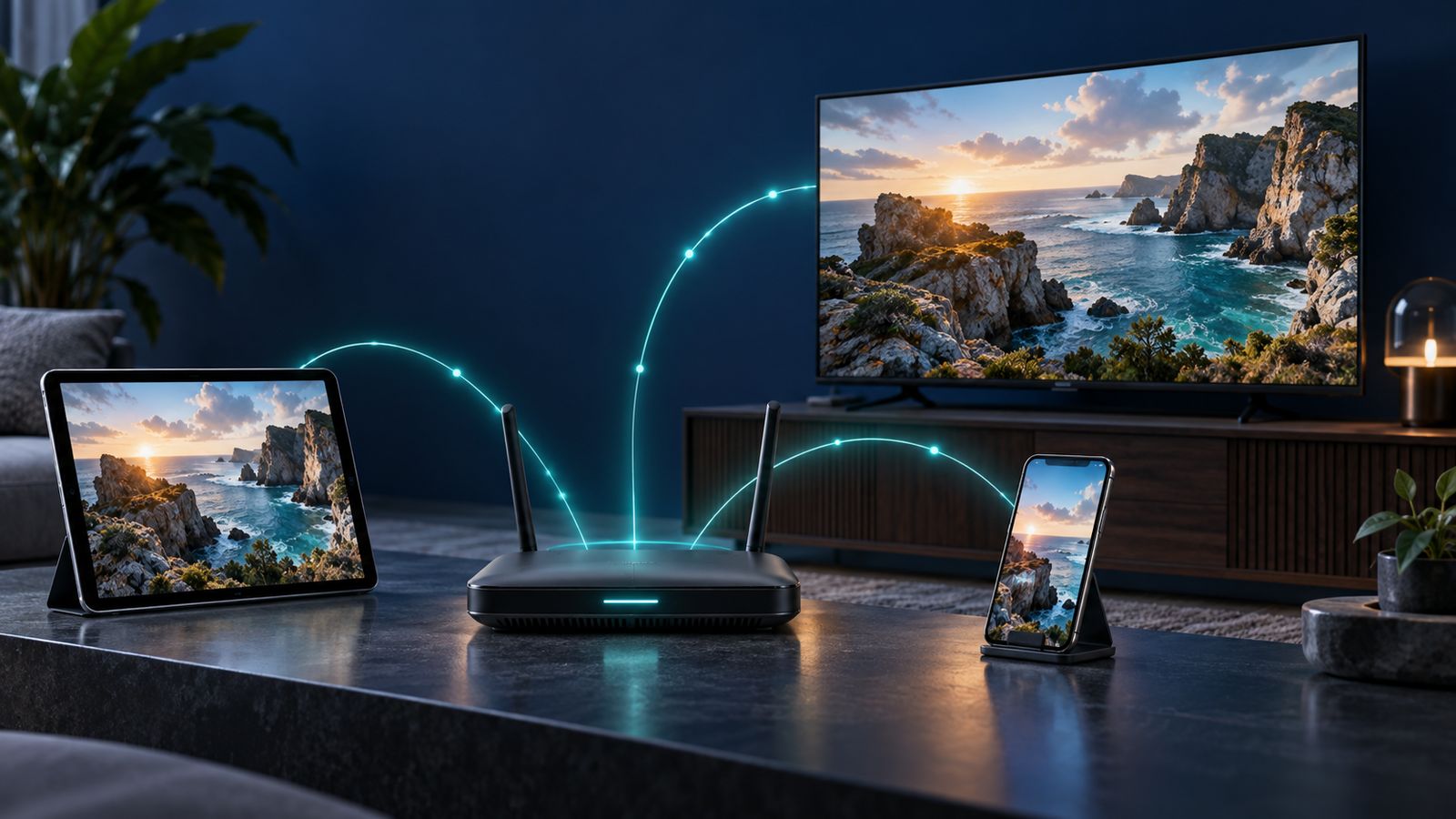
IPTV meaning: what IPTV stands for
IPTV stands for Internet Protocol Television. “Internet Protocol” is the set of rules that moves data across the internet. It is the same system that loads this page. IPTV uses it to carry video, so your TV picture arrives as data packets through your NBN connection rather than as a broadcast signal through a rooftop antenna.
You will also see it written as “IP TV”, “IP television”, “internet protocol TV” or “television over IP”. They all mean the same thing. In short, the meaning of IPTV is live and on-demand TV that arrives through your internet connection.
How does IPTV work?
A typical internet streaming service uses the following chain; delivery methods can differ:
- Source: the broadcaster or rights holder receives the channel feed or video file.
- Encoding: the video is compressed (usually with H.264 or the more efficient H.265/HEVC) so it can travel over the internet.
- Delivery: servers and content delivery networks (CDNs) send the video in small chunks using streaming formats such as HLS or MPEG-DASH.
- Playback: an app on your TV or device reassembles the chunks and adjusts the quality to your connection speed.
A service using adaptive streaming can reduce picture quality when the connection slows. Not every stream or player adapts in the same way. That is why a stable connection matters more than a very fast one.
Live TV, catch-up and on demand
IPTV services usually offer one or more of three formats:
- Live TV: channels play as they are broadcast, with a programme guide. Example: watching the ABC News channel live in the ABC iview app.
- Catch-up (time-shifted TV): recent programmes you can start from the beginning or replay for a few days after they air.
- Video on demand (VOD): a library of shows and films you pick and play at any time, like Binge.
IPTV vs antenna, satellite and streaming
| Method | How it arrives | Needs internet? | Typical use in Australia |
|---|---|---|---|
| Antenna (DTV) | Radio signal to a rooftop antenna | No | Free-to-air channels |
| Satellite | Signal from a satellite dish | No | Remote areas (VAST), older Foxtel |
| IPTV | Data over your internet connection | Yes | Hubbl, Kayo, Fetch, free-to-air apps |
| On-demand streaming | Data over your internet connection | Yes | Netflix, Binge, Stan |
In practice the line between IPTV and “streaming” has blurred. Most services now mix live channels and on-demand libraries in one app.
IPTV speed and data use
Use these approximate planning figures per screen, then confirm your provider’s requirements. They are not a measured requirement for every IPTV service.
| Quality | Speed per stream | Data per hour (approx.) |
|---|---|---|
| SD | 3 Mbps | ~1 GB |
| HD (720p/1080p) | 5 Mbps | ~3 GB |
| 4K | 15–25 Mbps | ~7 GB |
As a reference, Netflix recommends 3 Mbps for 720p, 5 Mbps for 1080p and 15 Mbps for 4K. Its data-use guidance lists up to 3 GB per hour for HD and 7 GB for 4K. Other services use different bitrates. Add capacity for simultaneous streams, video calls and downloads, then test the connection at the TV.
What you need to watch IPTV
- An internet connection: a stable connection meeting your provider’s requirements, with enough capacity for simultaneous use.
- A compatible screen: a smart TV, or any TV with a streaming device such as an Apple TV, Google TV Streamer, Fire TV or Hubbl. See our best IPTV box guide.
- An app: the service's official app or a player app. See our IPTV apps guide.
- A compatible subscription: confirm your player, login format and simultaneous screen limit using our IPTV setup checklist.
Is IPTV legal in Australia?
Yes. IPTV is a delivery method, and most Australian TV services use it. What matters is whether a service holds the rights to the channels it streams in Australia. Services that do not can be blocked by court order under section 115A of the Copyright Act. Our guide to whether IPTV is legal in Australia explains the law and how to check a service.
IPTV terms explained
- EPG (electronic programme guide): the on-screen TV guide showing what is on now and next.
- M3U playlist: a text file listing channel stream addresses, which player apps can load.
- Xtream Codes login: a server address, username and password format that many player apps accept.
- Multicast / unicast: multicast sends one stream to many homes on a managed network. Unicast sends a separate stream to each viewer, which is how most internet services work.
- Set-top box (STB): a small box connected to your TV that runs IPTV apps.
Frequently asked questions
What does IPTV stand for?
IPTV stands for Internet Protocol Television: television delivered using the same internet protocol (IP) that carries web pages and email, instead of radio waves, satellite signals or cable.
Is IPTV the same as streaming?
Mostly, yes. “Streaming” usually means on-demand services like Netflix, while “IPTV” often refers to live TV channels over the internet. Both use your internet connection, and many services now offer both.
Does IPTV need the internet?
Yes. IPTV only works with an internet or private IP network connection. Without one you cannot receive channels, although some apps let you download shows to watch offline.
How much data does IPTV use?
Roughly 1 GB per hour in SD, about 3 GB per hour in HD and around 7 GB per hour in 4K. Actual usage depends on bitrate and playback settings; check your home or mobile data allowance.
How does IPTV work?
The broadcaster encodes the channel, servers send it over the internet in small chunks using formats such as HLS, and an app on your TV reassembles and plays them. Adaptive streaming lowers the quality if your connection slows, instead of stopping.
Is IPTV free?
Some IPTV is free. ABC iview, SBS On Demand, 7plus, 9Now and 10 stream their live channels at no cost. Premium channels and live sport need a paid subscription from a provider.